
Useful Information, Places to Visit & Local Tips – Udon Thani

Udon Thani
Udon Thani (อุดรธานี) is one of the प्रमुख provinces of northeastern Thailand (Isan), situated on a fertile plateau near the border with Laos. Once a predominantly rural region, it has evolved into a strategic transportation and commercial hub thanks to its international airport, extensive road and rail networks, and its historical importance during the Vietnam War era.
The province is also renowned for its rich cultural and archaeological heritage, most notably Ban Chiang, a prehistoric archaeological site recognized as a UNESCO World Heritage Site. Blending rural traditions with carefully managed urban development, Udon Thani represents a Thailand that is balanced, practical, and forward-looking.
Located approximately 560 kilometers northeast of Bangkok, Udon Thani enjoys a strategic position close to the Lao border, making it an important gateway for trade, tourism, and regional connections.
Today, the city of Udon Thani is one of the most dynamic urban centers in Isan. Modern and well organized, it combines the convenience of a thriving city with the welcoming atmosphere of provincial Thailand. Shopping malls, high-quality hospitals, universities, and public infrastructure exist alongside traditional markets and a local way of life that remains deeply rooted in long-established customs and traditions.
Access & Transportation
- Udon Thani International Airport: Daily flights to and from Bangkok, with connections to other major destinations.
- Railway Station: Located on the Bangkok–Nong Khai railway line, providing convenient access to northeastern Thailand.
- Road Network: Well-developed highways and frequent interprovincial bus services connect Udon Thani with the rest of the country.
Population & Language
- Population: Approximately 1.6 million residents across the province.
- Languages: Thai and Isan are the primary languages, while English is commonly understood in urban areas and tourist locations.
Tropical Climate
- Hot Season: March to May
- Rainy Season: May to October
- Cool Season: November to February
Economy & Services
- An economy driven by agriculture, trade, services, and education
- Modern infrastructure, including shopping malls, universities, and both public and private hospitals
Places to visit
1. Red Lotus Lake Kumphawapi
Udon Thani Red Lotus Lake
A relaxing boat ride across Udon Thani’s Red Lotus Lake offers visitors the chance to discover a fascinating blend of flora and fauna, all set against the breathtaking backdrop of thousands of blooming lotus flowers—the undisputed stars of this extraordinary natural wonder.
The experience is an intimate encounter with nature. As the boat glides quietly through the water, visitors are surrounded by giant lotus leaves, colorful blossoms, and a rich variety of birds and aquatic life, creating a peaceful atmosphere unlike anywhere else in Thailand.
Near the lakeshore, a charming collection of cafés and small market-style stalls welcomes travelers looking to enjoy a refreshing drink or browse local products. A colorful rainbow-themed pier has also become a popular photo spot, adding a playful touch to the natural scenery and making the visit even more memorable.
Often described as one of the hidden gems of Thailand’s ever-surprising Isan region, the Red Lotus Lake is especially spectacular between December and February, when millions of pink-red lotus flowers bloom across the water. Covering an area of approximately 36 square kilometers, the lake is one of the largest seasonal lotus fields in the world and is best explored in the early morning, when the flowers are fully open and the light is at its most magical.
More than just a sightseeing destination, the Red Lotus Lake offers a serene and unforgettable experience where nature, tranquility, and local life come together in perfect harmony.
2. Wat Pa Phu Kon
Wat Pa Phu Kon
The Wat Pa Phu Kon temple complex was built between 2010 and 2013 through donations from a Thai benefactor in tribute to King Bhumibol Adulyadej. The architectural ensemble is centered around the Grand Wihan, the site’s main and most imposing building, surrounded by several smaller structures that blend harmoniously into the surrounding landscape.
One of the temple’s most remarkable features is its magnificent 20-meter-long Reclining Buddha. Crafted from blocks of white marble imported from Italy and meticulously sculpted in Thailand, the statue is a masterpiece of elegance and serenity, inspiring quiet contemplation among visitors.
The complex also includes a 25-meter-high golden stupa, visible from afar and serving as a powerful spiritual landmark within the temple grounds.
Often referred to as the Forest Temple, Wat Pa Phu Kon is nestled in an unspoiled natural environment of rolling hills and lush woodland, offering a peaceful retreat away from the bustle of the city. Although it is administratively located in Udon Thani Province, it is geographically closer to Nong Khai, making it a popular and rewarding day trip for visitors exploring the region.
3. Wat Pa Sri Khunaram
Wat Pa Sri Khunaram
Wat Pa Sri Khunaram (วัดป่าศรีคุณาราม) is a Theravāda Buddhist forest temple located in northeastern Thailand, set within a peaceful and well-preserved natural environment. True to the spirit of the wat pa tradition, the temple is dedicated to meditation, monastic discipline, and spiritual practice, offering a serene retreat far from the bustle of everyday life.
The temple is distinguished by its calm and contemplative atmosphere. Its simple yet elegant architecture blends seamlessly with the surrounding woodland, creating an ideal setting for reflection and inner peace. Prayer halls, monks’ kutis (individual dwellings), and meditation areas are thoughtfully designed to encourage silence, mindfulness, and introspection.
Wat Pa Sri Khunaram is highly respected by Thai devotees as well as by visitors seeking authenticity and spiritual tranquility. It embodies a form of Buddhism deeply rooted in tradition, where nature, simplicity, and moral discipline are at the heart of daily life, inviting all who visit to slow down and reconnect with themselves in a setting of profound serenity.
4. Wat Pa Chaiwan
Wat Pa Chaiwan
Wat Pa Chaiwan (วัดป่าไชยวาน) is a Theravāda Buddhist forest temple located in Udon Thani Province, surrounded by a peaceful and unspoiled natural landscape. Faithful to the wat pa tradition, the temple emphasizes meditation, monastic discipline, and spiritual practice, offering a tranquil environment dedicated to inner reflection and mindfulness.
The site is characterized by its atmosphere of simplicity and serenity. The temple’s prayer halls, monks’ residences, and meditation areas are intentionally modest in design, blending harmoniously with the surrounding forest and reinforcing the close connection between nature and spiritual life.
Wat Pa Chaiwan is visited by both local devotees and travelers seeking silence, authenticity, and a deeper understanding of Thai Buddhist traditions. Far from the crowds, it offers a genuine experience of forest monasticism, where contemplation, simplicity, and respect for nature form the foundation of everyday practice.
5. Ban Chiang Archaeological Site & Pottery Museum
Ban Chiang: Where the Ancient Heart of Humanity Still Beats
Ban Chiang—even its name carries the quiet gravity of places that witnessed the dawn of humanity and allowed it to unfold at its own rhythm, without haste or noise. It is one of those rare sites where the past does not sleep; it still whispers through the red earth, the pottery shards, and the hand-drawn patterns created thousands of years ago.
Located in Udon Thani Province, in northeastern Thailand, Ban Chiang is one of Southeast Asia’s most significant archaeological sites. Designated a UNESCO World Heritage Site in 1992, it bears witness to a civilization more than 5,000 years old, with some archaeological layers dating back 6,000 to 7,000 years. This was long before the Thai kingdoms, long before Angkor, and long before the invention of writing. It was the dawn of settled communities, agriculture, and metallurgy.
What makes Ban Chiang truly remarkable is its astonishing technological advancement for such an early period. Archaeologists have uncovered:
- Bronze tools
- Jewelry
- Weapons
- Carefully arranged human burials
- And above all… its legendary pottery.
Ban Chiang pottery is instantly recognizable. Its signature lies in the elegant red spiral motifs painted on a light-colored surface, often combined with geometric lines and organic patterns. Nothing is rigid or mechanical; every curve feels fluid, alive, almost dancing across the clay. You can sense the artisan’s hand, breath, and rhythm in every piece. It is an art form deeply connected to nature, to cycles of life, and to the sacred.
These ceramics were far more than decorative objects. They served as:
- Food storage vessels
- Funeral offerings
- Ritual objects
- Everyday household items
Together, they tell the story of a structured, peaceful society based on agriculture, craftsmanship, and spiritual beliefs—a civilization that mastered bronze technology earlier than many other regions of the world. From a historical perspective, this is nothing less than a quiet revolution.
The Ban Chiang National Museum, built directly on the archaeological site, presents this history with remarkable clarity and intelligence. Rather than simply displaying artifacts in glass cases, it explains the site’s stratigraphy, excavation methods, dating techniques, and archaeological theories. Visitors literally walk above history, with glass floors revealing ancient burials and artifacts preserved exactly where they were discovered. The presentation is elegant, informative, and rigorously scientific, focusing on archaeology rather than spectacle.
Nearby, the Pottery Museum and local artisan workshops keep this ancient tradition alive. Craftsmen reproduce ancestral designs using traditional techniques: slow hand-shaping, natural firing methods, and mineral pigments. Some pieces are faithful educational replicas, while others are original creations inspired by Ban Chiang’s timeless aesthetic. Here, the connection between past and present remains vibrant and continuous rather than frozen in time.
That is the true greatness of Ban Chiang.
It is not a dead archaeological site.
It is a living memory.
In a country often celebrated for its tropical beaches and golden temples, Ban Chiang reminds visitors that Thailand is also the cradle of ancient civilizations, patiently rooted in the earth and profoundly human in spirit.
For those who are drawn to places where the ancient heartbeat of the world can still be felt, Ban Chiang is more than a destination—it is a pilgrimage. Not merely a tourist attraction, but an inner journey. A place where you slow down, listen, and remember that we are all shaped by earth, fire, water, and time.
And perhaps that is the greatest gift this remarkable place has to offer.
6. Phu Phra Bat Historical Park
Phu Phra Bat Historical Park
Phu Phra Bat Historical Park is one of the must-see attractions in Udon Thani Province, renowned not only for its extraordinary and strangely shaped rock formations but also for its remarkable spiritual and religious sanctuaries.
The site’s earliest shrines date back to the Dvaravati period (7th to 10th centuries) and reflect a fascinating blend of Hindu and Buddhist influences. Set amid a landscape sculpted by nature over millions of years, these ancient sanctuaries create a unique atmosphere where history, archaeology, spirituality, and natural beauty come together, making Phu Phra Bat one of northeastern Thailand’s most captivating cultural treasures.
Phu Phra Bat is located in the western section of the Phu Phan Mountain Range, between Udon Thani and Nong Khai, approximately 65 kilometers from both cities. Covering an area of about 4.9 square kilometers, the historical park lies within the Phu Phra Bat Bua Bok Forest Park.
The site is famous for its extraordinary rock formations, including towering pinnacles, balanced boulders, and massive sandstone outcrops that provide a spectacular setting for prehistoric rock art and ancient religious sanctuaries. These unusual natural sculptures are believed to have been shaped by underwater erosion processes that occurred around 15 million years ago, creating one of the most distinctive landscapes in northeastern Thailand.
The combination of geological wonders, archaeological remains, and sacred monuments makes Phu Phra Bat a unique destination where nature and history have been intertwined for thousands of years.
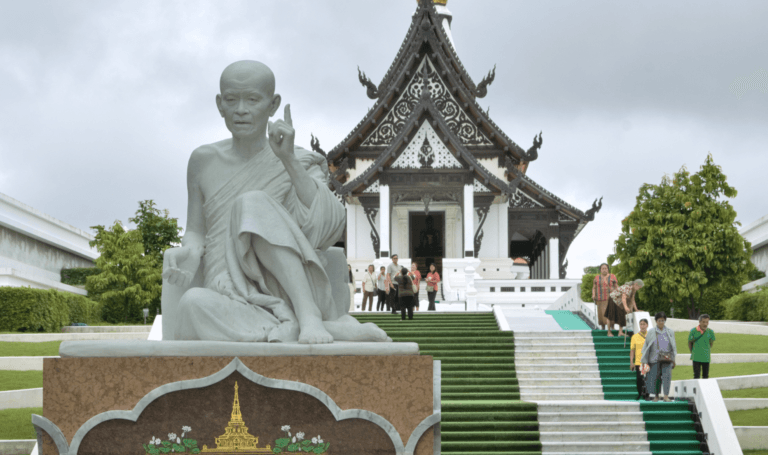
7. Dhamma Chedi Museum – Wat Pa Ban Tat
A meditation place closely associated with the highly respected Luang Ta Maha Bua, a master of the Thai forest tradition. There is no folklore here—only discipline, silence, and grounded practice.
The forest itself becomes the temple.
The temple becomes breath.
A place of striking and masterful simplicity.
8. Baan Khiri Wong Kot Udon Thani
Muban Khiri Wong Kot Eco Village
Muban Khiri Wong Kot is located in Amphoe Na Yung, connecting the western district of Udon Thani Province with Amphoe Pak Som in Loei Province to the east. Surrounded by lush green mountains, the village is set in a peaceful natural environment that reflects the beauty of rural northeastern Thailand.
Khiri Wong Kot has developed into a community-based ecotourism village, where local residents work together to welcome visitors and provide sustainable tourism services. The project is fully managed by the community, ensuring that tourism benefits are shared locally and remain closely tied to the village’s way of life.
Visitors can choose to stay with local host families or camp in tents, offering an immersive experience in rural living. The community primarily earns its livelihood through agriculture, guided by the principles of the sufficiency economy philosophy, and maintains a simple, self-reliant lifestyle.
Guests are welcomed with warmth and genuine hospitality, experiencing a way of life that is humble, peaceful, and deeply connected to nature.
In the heart of the mountainous forest, within the winding terrain of Na Yung District, your adventure begins in a remote upstream village. Here, visitors can enjoy the refreshing waters of Huay Chang Plai Waterfall, a natural retreat surrounded by dense greenery and the soothing sounds of the forest.
The experience continues with a countryside-style buffet, shared in a circle in a warm and communal atmosphere. Traditional dishes are served and enjoyed together, including rice cooked inside bamboo, spicy Thai papaya salad (som tam), grilled chicken, grilled fish, and a fragrant dill soup prepared in bamboo tubes.
This simple yet authentic setting offers a genuine taste of rural life, where nature, food, and community come together in perfect harmony.
9. UD Town Udon Thani Nignt market
Located next to Udon Thani Railway Station, you will find three night markets clustered around the intersection of Thong Yai Road and Prajak Sillapakom Road. The Udon Thani night markets open daily from around 5:00 p.m., and become especially lively on weekends, when live bands perform in the large bar area of Center Point Market, situated north of the station on the eastern side.
After sunset, the night markets become some of the most vibrant places in the city. Prices are generally very affordable, including both food and drinks, making it a popular destination for locals and visitors alike. People come here to stroll, shop, and enjoy the lively atmosphere.
The market activity also spills out onto the surrounding streets, where additional stalls line the sidewalks. These street-side vendors are often where the best bargains can be found, and they tend to attract the largest crowds, adding to the energetic and bustling character of Udon Thani’s night scene.
Arround Udon Thani
12. Wat Phu Tok Bueng Kan
Wat Jetiyakhiri (Wat Phu Tok)
Wat Jetiyakhiri is the official name of the temple, although it is more commonly known as Wat Phu Tok (วัดภูทอก). In the local Isan dialect, Phu Tok refers to the mountain, while Wat means temple.
Wat Phu Tok is considered one of the most remarkable attractions in the region. Although it is administratively located in Bueng Kan Province, north of Udon Thani, it remains one of the most impressive spiritual and scenic sites in northeastern Thailand.
The temple is situated roughly three to four hours east of Nong Khai and approximately 40 minutes from Udon Thani by car, making it a popular destination for a day trip or longer excursion.
Built dramatically on a steep sandstone hill, Wat Phu Tok is famous for its wooden walkways that wrap around the mountain in multiple levels, offering breathtaking views and a profound sense of elevation—both physical and spiritual. The experience is both awe-inspiring and deeply contemplative, as visitors ascend through the seven levels of the mountain, each symbolizing a step on the path toward mindfulness and enlightenment.
The monk Luang Pu Juan founded the temple and initiated the construction of wooden stairs, ladders, and walkways across the mountain, linking various shrines and meditation spaces. Over time, seven distinct levels were created, corresponding to the seven stages of Buddhist meditation, forming a symbolic path of spiritual ascent.
Unfortunately, Luang Pu Juan later died in a plane accident. However, Wat Phu Tok has been carefully preserved and continues to stand as a majestic and deeply inspiring site.
A visit typically takes around two hours at a moderate pace, although allowing extra time is recommended for photography and reflection along the way.
Appropriate attire is essential. Even though it involves hiking, this remains a sacred site. Visitors are expected to wear respectful clothing—long pants and sleeved shirts are recommended—and sturdy walking shoes are strongly advised for the climb.

Need a Vehicle and a Local Guide?
If you’re looking for personalized transportation and an authentic local experience, we highly recommend Ampha and Jojo.
Ampha is a Thai guide fluent in both French and English, with a genuine passion for her country, its culture, and its traditions. Warm, professional, and attentive, she will introduce you to the authentic side of Thailand, taking you far beyond the usual tourist routes.
Her husband, Jojo, is an experienced and reliable driver who will ensure a safe and comfortable journey throughout your stay.
You will like this too...
Udon Thani International Horticultural Expo 2026: Where Thailand Celebrates the Living World
There are events that go far beyond mere entertainment. They...
Read More

Nice restaurants, markets, and friendly bistros in Udon Thani and Nong Khai.
Our farm isn’t the only great place in Udon Thani…...
Read More
IMMERSION IN THAILAND: DISCOVER THE TRUE CHARMS OF AUTHENTIC THAILAND
Encounters in the Heart of Nature: Escape to Authentic Thailand,...
Read More
Edible Forests: An Enchanting Name for Real Sustainable Solutions…
If you’ve ever wandered along the back roads of a...
Read More